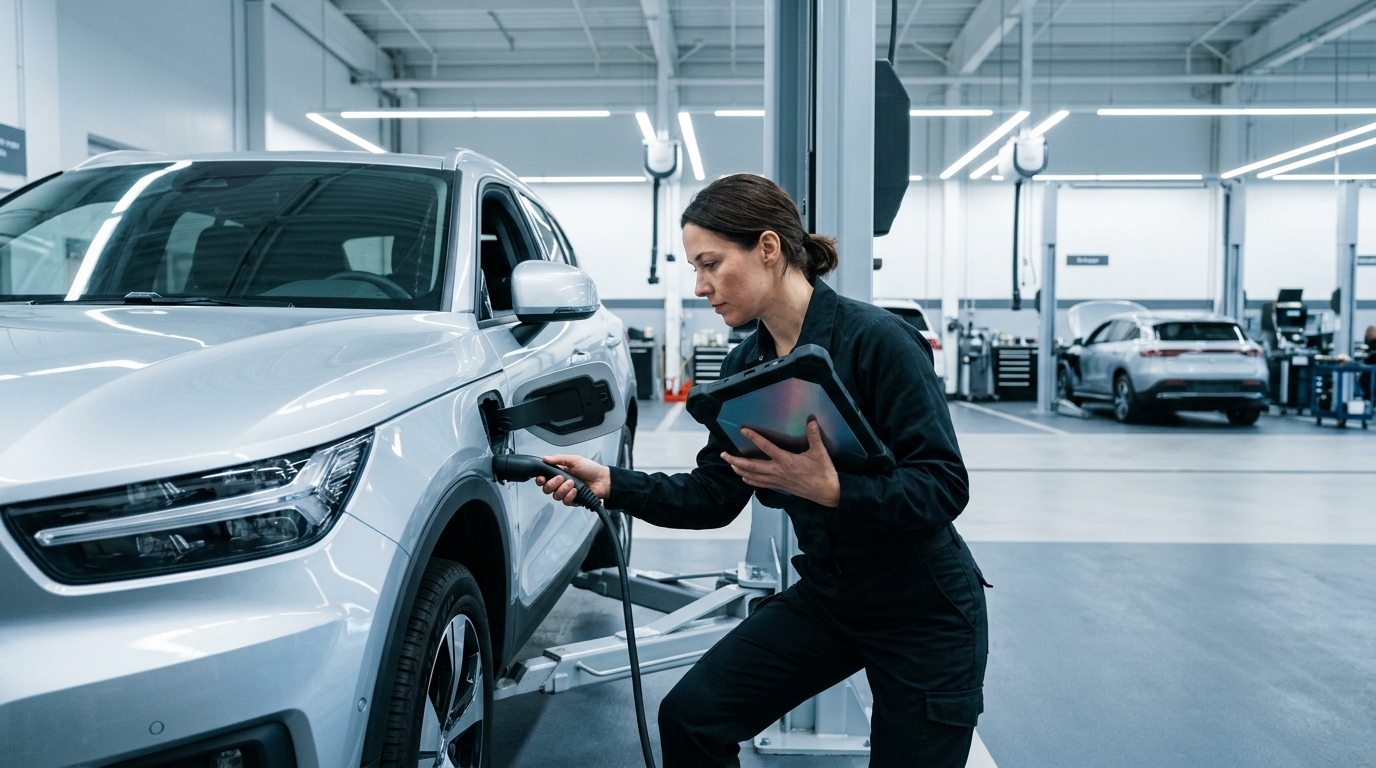
Electric vehicles require significantly fewer scheduled maintenance visits than gasoline cars - eliminating oil changes, spark plugs, timing belts, and transmission fluid entirely, while introducing new service needs around battery health, software updates, and thermal management systems.
If you recently switched to an EV or are considering one, understanding exactly where the maintenance overlap ends and the differences begin saves you money and prevents expensive surprises. Here's a precise breakdown of what changes, what stays the same, and what the actual cost differences look like.
What You No Longer Need to Do
The internal combustion engine (ICE) requires a long list of consumables and moving parts that simply don't exist in a battery electric vehicle. Removing these is the core reason EV ownership costs less over time.
- Oil changes: Gone entirely. No engine oil, no oil filter, no oil change intervals every 5,000–10,000 miles.
- Spark plugs and ignition system: EVs have no combustion cycle, so there's nothing to ignite.
- Timing belts and chains: Not applicable - no camshaft or crankshaft relationship to maintain.
- Transmission fluid and clutch: Most EVs use a single-speed reduction gear. No multi-speed gearbox means no fluid changes and no clutch wear.
- Exhaust system: No catalytic converter, muffler, or exhaust pipe to inspect or replace.
- Fuel injectors and fuel filters: No fuel system at all.
- Coolant flushes (engine-specific): EVs use thermal management coolant for the battery and motor, but at far longer intervals than ICE engine coolant.
A 2022 Consumer Reports study found that EV owners spent roughly 40% less on maintenance and repairs than gasoline vehicle owners over the first three years of ownership. That gap has widened as EVs have matured and as ICE repair costs have risen with parts inflation through 2025 and into 2026.
What EV Maintenance Still Requires
EVs aren't zero-maintenance vehicles. Several systems demand regular attention, and neglecting them carries real consequences.
Tires
This is the single biggest ongoing maintenance cost for EV owners, and it often catches people off guard. Electric vehicles are heavier than comparable gas cars due to battery weight, and they deliver instant torque that accelerates tire wear. Expect to rotate tires every 6,000–7,500 miles - more frequently than the 10,000-mile interval common on lighter ICE vehicles. Many EV owners report needing new tires 20–30% sooner than they did with gas cars.
Brakes
Regenerative braking is a genuine advantage here. Because the motor recaptures kinetic energy when you lift off the throttle, friction brakes on EVs work far less than on gas cars. Many EV owners go 80,000–100,000 miles before needing brake pad replacement. However, the flip side is that brake rotors can develop surface rust faster from underuse, particularly in humid climates. Regular firm brake applications every few weeks prevent rotor corrosion from becoming a problem.
Battery Health Monitoring
The high-voltage battery pack is the most expensive component in any EV - replacement costs range from $8,000 to $20,000 depending on vehicle and pack size. While battery degradation is gradual and predictable, you should actively monitor state-of-health (SOH) through your vehicle's app or a third-party tool like Recurrent. Keep the charge between 20% and 80% for daily use, avoid repeated DC fast charging sessions when possible, and park in moderate temperatures. Most manufacturers warrant the battery to at least 70% capacity for 8 years or 100,000 miles.
Cabin Air Filter
EVs still pull in outside air for the cabin HVAC system. Replace the cabin air filter every 15,000–25,000 miles depending on your driving environment. Urban or dusty environments warrant more frequent changes.
Thermal Management System
The battery thermal management system uses a coolant loop to keep the pack within optimal operating temperature. Most manufacturers recommend inspecting this fluid around 150,000 miles, though some schedule a check at 5 years regardless of mileage. Don't ignore this - overheating is one of the primary accelerators of battery degradation.
Wiper Blades and Washer Fluid
Identical to any car. Replace blades once a year or when streaking starts.
Software Updates
This is entirely new territory for car owners coming from the ICE world. EVs receive over-the-air (OTA) software updates that affect charging behavior, battery management algorithms, range estimates, and driver assistance features. Keeping your vehicle's software current isn't optional - outdated firmware can limit charging speed or affect thermal management. Most updates install automatically overnight when plugged in.
EV vs. Gas Car Maintenance: Side-by-Side Comparison
Maintenance Item Gas Car Electric Vehicle Oil changes Every 5,000–10,000 miles Not required Brake pads Every 30,000–50,000 miles Every 80,000–100,000 miles Tire rotation Every 7,500–10,000 miles Every 6,000–7,500 miles Transmission service Every 30,000–60,000 miles Not required (single-speed) Spark plugs Every 30,000–100,000 miles Not applicable Cabin air filter Every 15,000–25,000 miles Every 15,000–25,000 miles Battery/coolant system Flush every 30,000–50,000 miles Inspect at ~150,000 miles or 5 years Software updates Dealer-only, infrequent OTA, regular and automaticThe Real Cost Difference
Annual maintenance costs for a midsize gas car in 2026 average around $1,000–$1,400 when accounting for oil changes, filters, spark plugs, and routine inspections. A comparable EV averages $400–$700 annually, with tires being the dominant expense. The savings compound significantly over 100,000 miles - EV owners typically spend $4,000–$7,000 less on maintenance over that span compared to ICE vehicle owners.
The one area where EVs can exceed gas car costs is out-of-warranty battery replacement. If your pack degrades below manufacturer thresholds before the warranty expires, replacement is covered. After warranty, costs are substantial. This is why purchasing an EV certified pre-owned with remaining factory battery warranty is a smarter move than buying one with an expired warranty and unknown battery history.
Finding a Qualified EV Technician
Not every mechanic is trained for high-voltage systems. For routine work like tires, brakes, and cabin filters, any competent shop handles the job fine. For battery diagnostics, thermal management, or anything involving the high-voltage system, use a manufacturer-certified service center or a shop with ASE L3 Electric Vehicle certification. Working on a high-voltage battery pack without proper training and equipment is genuinely dangerous.
Tesla, Rivian, and Lucid operate proprietary service networks. GM, Ford, Hyundai, and Kia EVs are serviced through their broader dealer networks, most of which now have dedicated EV-trained technicians. Independent EV specialists are increasingly common in urban areas.
Do EVs need oil changes?
No. Electric vehicles have no internal combustion engine and therefore no engine oil or oil filter. Oil changes are completely eliminated, which removes one of the most frequent and routine maintenance costs gas car owners face.
How long do EV brakes last compared to gas car brakes?
EV brake pads typically last 80,000–100,000 miles, compared to 30,000–50,000 miles on a gas car. Regenerative braking handles the majority of deceleration, dramatically reducing friction brake usage and wear.
How do I keep my EV battery healthy long-term?
Keep the state of charge between 20% and 80% for daily use, limit DC fast charging to when you actually need it, avoid storing the vehicle at very high or very low charge levels in extreme temperatures, and keep the vehicle's software updated. These practices measurably slow battery degradation over time.
Are EV tires more expensive than regular tires?
Yes, in most cases. EVs require tires rated for higher load capacity and optimized for low rolling resistance. These tires typically cost 10–20% more than standard equivalents. Combined with faster wear rates from vehicle weight and instant torque, tire costs are the largest routine maintenance expense for most EV owners.
Can a regular mechanic work on an electric vehicle?
For non-electrical work - tires, wiper blades, cabin air filters, brake pads - yes, any qualified mechanic handles the job safely. For anything involving the high-voltage battery pack, charging system, or motor inverter, use a technician with ASE L3 Electric Vehicle certification or a manufacturer-authorized service center. High-voltage systems operate at 400–800 volts and require specialized training and safety equipment.